
 By
By 
Contents
Mobile apps run the engine of modern business. From how companies acquire customers to how they deliver services, everything flows through the small screen in your users’ pockets. But here is the part that catches most entrepreneurs off guard: the cost to maintain an app after launch is a serious ongoing commitment, and getting it into the app store is just the starting line, not the finish line.
Think of it this way. Would you buy a brand-new car and never get the oil changed, never rotate the tires, and never take it in for a service check? Of course not. The same logic applies to your mobile app. The digital marketplace is unforgiving, and users have zero tolerance for apps that crash, load slowly, or feel outdated.
The numbers back this up. Google Play Store currently hosts over 1.58 million apps, while the Apple App Store features roughly 2.09 million apps across different categories. Both platforms actively remove low-quality and abandoned apps from their stores. In fact, according to a Pixalate report, Google removed 1.1 million apps from the Play Store in Q2 2024 alone, with 74% of those not updated in over two years.
Every successful app requires ongoing software maintenance. We are talking about bug fixes, security patches, user experience improvements, and competitive feature updates. Most business owners are surprised when they find out that mobile app maintenance costs typically consume 15% to 20% of what they originally spent on development every year. But this recurring investment pays for itself by protecting your app’s performance, improving user retention, and keeping you a step ahead of competitors.
In this blog, we will break down exactly how much it costs to maintain an app in 2026 and share proven ways to keep those expenses under control. Space-O has built and maintained over 4400 applications as a leading mobile app development company. From healthcare to fintech, our team has delivered post-launch support across industries, and everything in this guide is based on that real-world experience. If you are looking for mobile app maintenance services that fit your budget, this breakdown will help you plan with confidence.
Let’s start with the actual numbers. All costs mentioned throughout this blog are in USD.
How Much Does App Maintenance Cost in 2026?
On average, app maintenance costs 15% to 20% of the total cost of app development per year. So if your app costs $100,000 to build, you should expect to spend between $15,000 and $20,000 annually on maintenance alone.
However, this percentage is only a baseline. The actual cost can vary significantly depending on factors like your app’s complexity, the number of platforms you support, your hosting infrastructure, and how frequently you release updates. Understanding these variables is essential to calculating the total cost of ownership (TCO) of your mobile application, which extends far beyond the initial development investment.
Here is a quick summary of what your annual maintenance budget looks like across different development cost ranges.
| Total App Development Cost | Annual Maintenance Cost (15% to 20%) | Monthly Maintenance Cost |
| $30,000 | $4,500 to $6,000 | $375 to $500 |
| $50,000 | $7,500 to $10,000 | $625 to $833 |
| $100,000 | $15,000 to $20,000 | $1,250 to $1,667 |
| $150,000 | $22,500 to $30,000 | $1,875 to $2,500 |
| $250,000 | $37,500 to $50,000 | $3,125 to $4,167 |
| $500,000+ | $75,000 to $100,000+ | $6,250 to $8,333+ |
These figures cover core maintenance tasks such as server hosting, bug fixes, OS compatibility updates, security patches, third-party API maintenance, and periodic feature enhancements. In the sections below, we will break down each factor that influences the cost to maintain an app so you can plan your budget accurately.
Get the Exact Cost to Maintain Your App Today
Share your app details with our team and receive a custom maintenance cost estimate within 24 hours

The Hidden Costs of Maintaining an App: Expenses Most Businesses Overlook
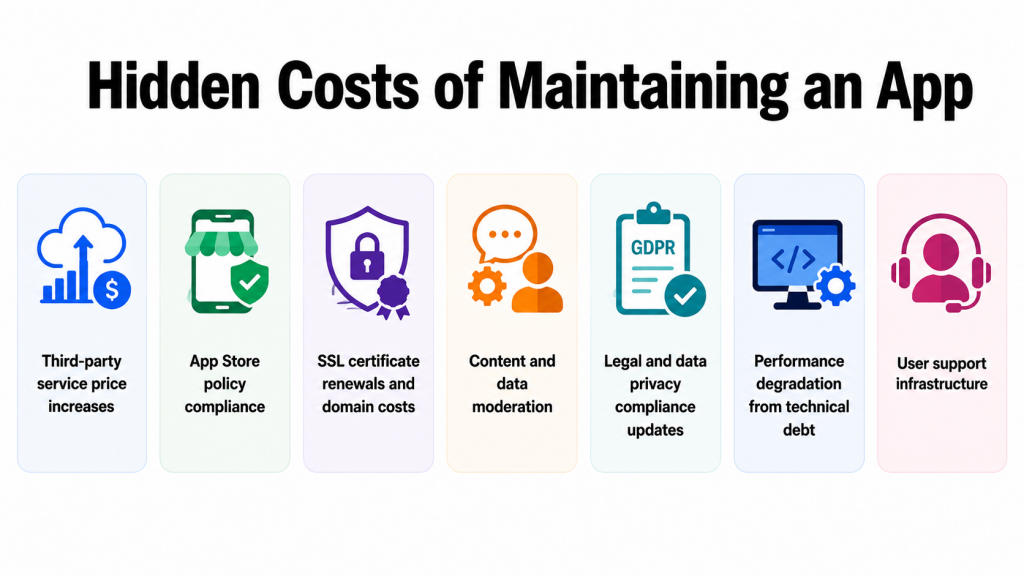
Most businesses budget for the obvious items like hosting and bug fixes. But several recurring costs often catch app owners off guard after launch. Understanding these hidden expenses upfront can save you from budget overruns and ensure long-term app stability.
Third-party service price increases
Many apps depend on services like cloud storage, push notification platforms, email delivery APIs, and analytics dashboards. These services often have usage-based pricing. As your user base grows, the costs for these third-party services grow proportionally. A push notification service that costs $50/month with 10,000 users could cost $500/month or more when you scale to 100,000 users.
App Store policy compliance
Both Apple and Google regularly update their developer policies. For example, Apple now requires apps to meet specific privacy disclosure standards, while Google enforces target API level requirements. Failing to comply with the deadline can result in your app being removed from the store. The cost of updating your app to meet new store policies can range from $1,000 to $5,000 per compliance cycle, depending on the scope of changes required.
SSL certificate renewals and domain costs
If your app communicates with a backend server (which most do), you need to maintain valid SSL certificates, domain registrations, and DNS configurations. While individual renewal costs are modest ($50 to $200/year), forgetting to renew them can cause outages that damage user trust.
Content and data moderation
Apps with user-generated content, chat features, or community functionality require ongoing moderation. Whether you use AI-based moderation tools or manual review, this is a recurring cost that many businesses underestimate. Automated moderation tools can cost $200 to $2,000/month, depending on volume, while human moderation teams add to operational overhead.
Legal and data privacy compliance updates
Regulations like GDPR, CCPA, and India’s DPDP Act require regular compliance audits. If your app collects user data, you need to update data privacy policies, consent mechanisms, and data handling workflows every time regulations change. Legal consultation and implementation for compliance updates can cost $2,000 to $10,000 annually.
Performance degradation from technical debt and legacy code
Over time, quick fixes and workarounds accumulate as technical debt. If not addressed proactively, this debt compounds within your legacy code, leading to slower performance, higher crash rates, and more expensive future updates. Many businesses do not account for periodic code refactoring, which can cost $5,000 to $15,000 depending on the codebase size. Inherited codebases carry the highest risk. When we took over the CallRecorderPro call recording app, a dependency audit surfaced deprecated packages and compatibility issues across both platforms.
User support infrastructure
As your app’s user base grows, so does the volume of support tickets, bug reports, and feature requests. You may need to invest in helpdesk software, chatbot integrations, or dedicated support staff, all of which add to the ongoing cost of maintaining your app.
By accounting for these hidden costs early, you get a clearer picture of how much does an app cost to maintain and can set a realistic budget that prevents disruptions.
How Much Does It Cost to Maintain an App Based on Complexity Level?
The complexity of your application is one of the biggest determinants of ongoing maintenance costs. Here is how costs break down across three levels.
- Simple apps (calculators, to-do lists, timers) cost $5,000 to $10,000 per year. These need minimal backend support, just OS updates, minor bug fixes, and basic hosting.
- Medium complexity apps (eCommerce, social media apps, logistics apps, food delivery) cost $15,000 to $50,000 per year. Whether you develop a SaaS application or a fitness tracker, these involve API integrations, payment gateways, push notifications, and analytics tracking. More moving parts mean higher maintenance costs, especially as your daily active users (DAU) grow into the tens of thousands.
- High-complexity apps (fintech apps, healthcare apps, enterprise ERP, AI-powered apps) cost $50,000 to $150,000+ per year. These operate in regulated industries requiring dedicated DevOps infrastructure, regular security audits, HIPAA or PCI DSS compliance, and scalability to handle traffic spikes without downtime.
Not sure where your app falls? Consider the number of screens, feature complexity, third-party integrations, and whether you handle sensitive data. These factors will give you a reasonable estimate of your expected maintenance costs.
Not Sure Which Maintenance Plan Fits Your App?
Our consultants will assess your app’s complexity level and recommend a maintenance plan that fits your budget and goals.
App Maintenance Cost Based on Different Locations
The cost of app maintenance varies based on the geographical location of your development team. Developers from different regions charge different hourly rates, which directly impacts your total maintenance budget.
- North America: $50 to $150 per hour
- South America: $30 to $80 per hour
- Western Europe: $40 to $100 per hour
- Eastern Europe: $25 to $80 per hour
- Australia: $40 to $100 per hour
- Asia (India, Philippines, Vietnam): $25 to $50 per hour
To put this in perspective, if your app requires 200 hours of maintenance work per year, the cost of hiring a developer at $100/hour in North America ($20,000/year) versus $35/hour in Asia ($7,000/year) creates a substantial difference. This is why many businesses opt for offshore maintenance partners who offer the same technical expertise at a fraction of the cost.
However, the cheapest option is not always the most cost-effective. When outsourcing, make sure to account for communication overhead, time zone differences, and the quality of documentation provided by the development team.
7 Benefits of Maintaining and Updating Mobile Apps
If you are thinking about why maintaining an app should be your priority task, here are the key benefits that make the cost to maintain an app a worthwhile investment.
- Minimizes app uninstalls: Regular crashes, bugs, and slow performance are among the top reasons users uninstall apps. By fixing issues promptly and releasing performance updates, you keep your existing users satisfied and reduce churn.
- Delivers a better user experience: User expectations evolve constantly. Maintaining your app allows you to refine the interface, improve navigation, optimize load times, and respond to user feedback. A well-maintained app keeps users engaged and encourages positive reviews on the app stores.
- Ensures safety from cyber attacks: Security vulnerabilities are discovered regularly in operating systems, third-party libraries, and APIs. If you do not patch these vulnerabilities through regular updates, your app becomes an easy target for data breaches and cyberattacks. Maintaining your app means staying ahead of security threats by applying patches, updating encryption protocols, and performing security audits.
- Keeps the app compatible with new OS versions: Apple and Google release major OS updates at least once a year. If your app is not updated to support these new versions, users on the latest devices may experience crashes, broken layouts, or missing features. Timely version updates ensure seamless compatibility across all supported OS versions and prevent your app from falling behind.
- Achieves better ROI in the long run: A well-maintained app retains users, attracts new ones through positive reviews, and generates consistent revenue. On the other hand, neglecting maintenance leads to a declining user base, lower app store rankings, and ultimately a loss on your initial development investment.
- Improves app store rankings through App Store Optimization (ASO): Both Apple and Google favor apps that are regularly updated. Frequent version updates signal to the app stores that your app is actively maintained, which can positively impact your App Store Optimization (ASO) efforts, boosting your visibility in search results and category rankings.
- Enables you to stay ahead of competitors: The mobile app market is highly competitive. If your competitors are releasing new features, optimizing performance, and addressing user feedback faster than you, your app risks becoming irrelevant. Regular mobile application maintenance gives you the agility to respond to market trends and user demands.
Why Is App Maintenance More Expensive in the First Year?
One of the most common surprises for app owners is discovering that the cost to maintain an app in the first year is significantly higher than in subsequent years. In fact, first-year post-launch support can cost up to 50% of the original development cost, compared to the standard 15% to 25% in the years that follow.
Here is why post-launch support costs spike in year one and when you can expect them to stabilize.
1. Post-launch bug volume and early user feedback cycles
No matter how thorough your pre-launch testing is, real-world usage always uncovers issues that testing environments cannot replicate. When thousands of users start using your app on different devices, network conditions, and OS versions, bugs surface rapidly.
In the first three to six months after launch, your development team will spend significant time triaging and fixing bugs reported by early users. Additionally, user feedback during this period tends to be high-volume and actionable, leading to rapid iterations on UI/UX, feature adjustments, and performance optimizations. This concentrated burst of development activity drives up costs.
2. Initial OS compatibility and device optimization
Your app may have been tested on a limited set of devices before launch. Once it reaches a broader audience, you will encounter device-specific issues, including screen resolution mismatches, hardware-specific crashes, and variations in how different manufacturers implement Android OS.
Similarly, if a major iOS or Android update is released shortly after your app’s launch, your team will need to invest time in ensuring full compatibility. This overlap of launch stabilization and OS updates can create a spike in maintenance effort during year one.
3. How costs stabilize from year two onward
By the end of the first year, the most critical bugs have been resolved, the app has been optimized for a wide range of devices, and your team has established a predictable update cycle. From year two onward, maintenance shifts from reactive firefighting to proactive improvement, which includes scheduled feature updates, routine security patches, and planned performance optimizations.
This transition is what brings the app maintenance cost per year down to the standard 15% to 20% range. The key is to plan for this first-year spike in your initial project budget so it does not come as an unpleasant surprise.
| Maintenance Phase | Estimated Cost (% of Development Cost) | Focus Areas |
| Year 1 (Post-Launch) | 35% to 50% | Bug fixes, device optimization, OS compatibility, user feedback iteration, performance tuning |
| Year 2 | 15% to 25% | Feature updates, security patches, API maintenance, analytics-driven improvements |
| Year 3+ | 15% to 20% | Routine updates, compliance, minor feature additions, and preventive maintenance |
What Factors Affect the Cost of Maintaining an App?
Different segments determine the overall cost of app maintenance, and each requires a separate budget allocation. In this section, we are going to discuss app maintenance costs per year and per month based on various factors.
This infographic will help you to calculate the costs depending on the chosen maintenance actions. Check the following table.
| App Maintenance Type | App Maintenance Charges |
| Hosting Charges | $70 to $320 per month |
| Bug Fixing and Updates | $1,000 to $2,000 per cycle |
| App Store Fees | $99 to $125 per year |
| Functional Services | $4,000 per year |
| API Integration | $5,000 per year |
| IT Support | $10,000 per year |
| Security and Compliance | $3,000 to $15,000 per year |
| Customer Support | $2,000 to $10,000 per year |
| Analytics | Free to $150,000 per year |
| Payment Gateways | $149 per month |
| Technical Intervention | $35 to $50 per hour |
1. Hosting charges to deploy your app
While calculating the app maintenance cost, hosting is one of the most significant expense heads that you need to consider. You can plan your server resources depending on the usage of app data, such as handling videos, audio, or text.
If you plan to increase your server resource capacity, you need to spend more. In short, the app maintenance cost for hosting servers can range from $70 to $320 per month.
There are various cloud-based hosting options that you can take advantage of when considering how much it costs to run an app. For example, Amazon Web Services (AWS) typically charges less than other hosting servers, as you only need to pay for what you use. Other popular options include Google Cloud Platform, Microsoft Azure, and DigitalOcean, each offering scalable pricing models.
Beyond basic server costs, your hosting expenses also include database management, storage costs for user data and media files, bandwidth costs for data transfer, CDN (Content Delivery Network) services for faster content delivery, and API hosting for your backend endpoints. For high-traffic apps, you will also need to budget for load balancing to distribute traffic across multiple servers and auto scaling to handle usage spikes without manual intervention.
For apps with moderate traffic (10,000 to 50,000 monthly active users), a basic cloud hosting setup on AWS or Google Cloud typically costs between $100 and $200 per month. For apps with heavy media content, real-time features, or high concurrency, this can scale to $500 or more per month once you factor in database management, CDN, and auto scaling costs.
2. Bug fixing and updates to implement benchmarks
Among ongoing mobile app maintenance costs, bug fixing is part of the mobile app development process. But updating your app on a regular basis helps you enhance the performance of the app and the user experience. However, there is no fixed charge to resolve bugs or update an app. It depends on the complexity of the app and the nature of the changes.
For example, if it is a simple bug fix, you will pay around $50 to $200. On the other hand, if it is a major functional aspect that you need to update, then it would cost you around $1,000 to $2,000, as developers will take two to three weeks to resolve these issues.
It is recommended to schedule regular update cycles (monthly or bi-monthly) rather than waiting for bugs to accumulate. Proactive updates reduce the risk of critical failures and are more cost-effective in the long run.
3. App store fees for iOS and Android
Every app owner needs to account for the cost to put app on the app store as a recurring expense. Apple charges an annual fee of $99 for its Apple Developer Program, which is required to publish and maintain apps on the App Store. Google charges a one-time registration fee of $25 for the Google Play Console.
However, the larger expense lies in the transaction fees. Both Apple and Google take a commission on in-app purchases and subscriptions.
| Platform | Developer Fee | Commission on In-App Purchases |
| Apple App Store | $99/year | 15% to 30% |
| Google Play Store | $25 (one-time) | 15% to 30% |
Apple’s Small Business Program and Google’s reduced service fee program lower the commission rate to 15% for developers earning under $1 million per year. For apps generating significant revenue through in-app purchases, these commissions can add up to a substantial annual cost.
Additionally, if you release a paid app, keep in mind that both stores take their commission from every purchase. This is not a maintenance cost per se, but it affects your revenue projections and should be factored into your overall budgeting.
4. Functional services to provide a better user experience
These services include actions that you take to communicate with your app users, such as push notifications, emails, SMS, and in-app chats. You may also rely on authentication services for social logins and identity verification. For all of these, you need third-party integration services and pay on a monthly subscription basis.
Popular services like Firebase Cloud Messaging (for push notifications), Twilio (for SMS), SendGrid (for emails), and authentication services like Auth0 or Firebase Authentication offer tiered pricing. As your user base grows, the cost of these functional services increases proportionally.
So if you are using functional services in your app, then you may expect to spend around $4,000 per year to maintain the best standards of user experience.
5. API integration to ensure seamless functioning
Just like functional services, you need to invest in the maintenance of third-party integration services or API services that you have used in your app. For example, you might have used Facebook integration for easy social media login, Google Maps for real-time location services, or Stripe for payment processing.
Every time there is an update or change to the API, you also need to make changes in your app accordingly. API providers frequently release new versions, deprecate old endpoints, and update authentication methods. If you do not keep up, your app’s functionality will break.
The maintenance for the API can cost you around $5,000 per year, depending on the number and complexity of integrations.
6. IT support to reduce downtimes
iOS and Android platforms release new updates regularly. When you launch your app on these platforms, you have to be aware of the fact that you will need to maintain your app to make it compatible with the new operating system updates.
Apple releases a major iOS update every September, with minor updates throughout the year. Google follows a similar cycle with Android releases. Each of these updates can introduce changes that affect your app’s performance, layout, or functionality.
With such changes in the operating systems and making the app compatible, you need to spend around $10,000 over a year on IT support and maintenance expenses.
7. Security, compliance, and regulatory update costs
Security is not a one-time setup. It is an ongoing cybersecurity responsibility. As cyber threats evolve and new regulations emerge, your app needs regular security updates to protect user data and maintain compliance with industry standards.
Key security maintenance tasks include updating SSL/TLS certificates, patching known vulnerabilities in third-party libraries, strengthening data encryption protocols, implementing multi-factor authentication (MFA) upgrades, conducting penetration testing, and performing regular security audits. Maintaining strong data privacy practices is also essential for user trust and regulatory compliance.
On the compliance side, regulations like GDPR (Europe), CCPA (California), HIPAA (US healthcare), PCI-DSS (payment processing), and SOC 2 (data security for SaaS providers) require periodic reviews and updates to data handling processes. Non-compliance can result in heavy fines, so this is not an area where you can cut corners.
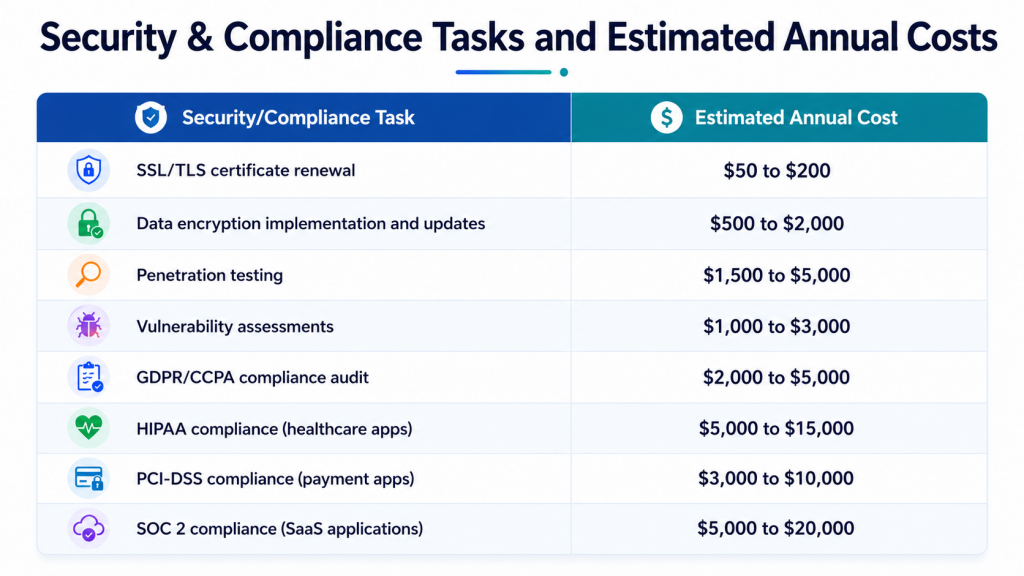
Depending on your app’s industry and the sensitivity of the data it handles, cybersecurity and compliance costs can range from $3,000 to $20,000 per year or more.
8. Customer support as an ongoing maintenance expense
Customer support is often overlooked when calculating app maintenance costs, but it is a critical component of keeping users happy and reducing churn. Investing in structured app support services ensures that user issues are resolved quickly, which directly impacts retention rates. As your app grows, the volume of support requests increases, and you need the infrastructure to handle them efficiently.
There are several ways to approach customer support for your app.
- In-app support tools: Integrating a help desk or ticketing system directly into your app (using tools like Zendesk, Freshdesk, or Intercom) costs between $50 and $500 per month, depending on the plan and number of agents.
- Chatbot integration: AI-powered chatbots can handle common queries and reduce the load on your human support team. Setting up and maintaining a chatbot costs between $200 and $1,000 per month.
- Dedicated technical support team: If your app has a large user base or handles sensitive transactions, you may need a dedicated technical support team with representatives available during business hours or around the clock. This can cost $2,000 to $5,000 per month per agent, depending on location and expertise.
- Knowledge base and FAQs: Creating and maintaining a self-service knowledge base reduces support ticket volume. While the initial setup cost is one-time ($500 to $2,000), updating it regularly adds to ongoing maintenance.
Overall, customer support as part of your app maintenance can cost anywhere from $2,000 to $10,000 per year for small to mid-sized apps, and significantly more for enterprise-level applications.
9. Business analytics to monitor app performance
Once you deploy your app, continuous app monitoring becomes essential. You will constantly need to track performance monitoring metrics, user analytics, and engagement data to find which features are loved or used most by your app users and which features are completely ignored. Also, to maintain the success of your app, you will be tracking engagement and conversion rates as well as your retention and churn rates.
Along with this, you need crash reporting and error tracking tools to identify bugs, crashes, and other glitches before they affect a large portion of your user base. For enterprise-level apps, business intelligence dashboards and Application Performance Monitoring (APM) tools provide deeper insights into server response times, API latency, and system health.
Here are some popular app monitoring and analytics tools and their pricing.
| Analytics/Monitoring Tool | Category | Pricing |
| Google Analytics (GA4) | User Analytics | Free (standard) |
| Google Analytics 360 | User Analytics / Business Intelligence | $150,000 per year |
| Firebase Analytics | User Analytics | Free |
| Mixpanel | User Analytics | Free tier available; paid plans from $20/month |
| Amplitude | User Analytics | Free tier available; paid plans from $49/month |
| Flurry Analytics | User Analytics | Free |
| Datadog | APM / Performance Monitoring | From $15/host/month |
| New Relic | APM / Error Tracking | Free tier available; paid from $25/host/month |
For most small- to mid-sized apps, free analytics tools like Google Analytics (GA4) and Firebase Analytics provide sufficient user analytics insights. For performance monitoring and crash reporting, tools like Datadog and New Relic offer APM capabilities that help identify bottlenecks and errors in real time. Larger enterprises with advanced analytics needs may invest in premium tools or even Google Analytics 360 for business intelligence and critical insights.
10. Payment gateways for hassle-free payments
When estimating the cost to maintain an app, whether you develop an eCommerce app, an on-demand delivery app, or any app that requires payment gateway integration to support online payments, you would also need a monthly subscription fee.
This may go up to $149 per month, and additionally, you would also need to pay a transaction fee for each payment processed through your app. Common payment gateway fees include:
| Payment Gateway | Monthly Fee | Transaction Fee |
| Stripe | $0 (pay-per-transaction) | 2.9% + $0.30 per transaction |
| PayPal | $0 to $30 | 2.99% + $0.49 per transaction |
| Braintree | $0 (pay-per-transaction) | 2.59% + $0.49 per transaction |
| Square | $0 (pay-per-transaction) | 2.6% + $0.10 per transaction |
| Authorize.Net | $25/month | 2.9% + $0.30 per transaction |
While the monthly subscription fees are relatively modest, the per-transaction fees can add up significantly for high-volume apps. This is an important factor to consider in your overall maintenance budget.
11. Technical intervention cost
Generally, app owners avoid including this cost while calculating app maintenance costs. However, monitoring and operating IT-specific interventions are very much part of the app maintenance life cycle.
In case you have an internal mobile app development team, then you do not have to pay any additional application maintenance charges. However, if you decide to outsource your app maintenance services, then you might consider technical intervention costs of around $35 to $50 per hour.
The technical intervention cost is influenced by the location of the mobile app developers. Developers in North America charge $50 to $150 per hour, while developers in Asia charge $25 to $50 per hour for the same quality of work.
Spending Too Much on App Maintenance Every Year?
Let our team audit your current maintenance expenses and identify areas where you can reduce costs without compromising app quality.
What Are the Different Types of App Maintenance and How Much Do They Cost?
If you are looking to outsource your mobile application maintenance requirements, then here are the different types of services that a professional app development company will offer you, along with the typical cost ranges for each type.
1. Emergency maintenance
You may experience sudden or unexpected errors in your app. In such scenarios, you need to address these issues immediately to maintain the app’s performance. Emergency maintenance is reactive by nature and is triggered by critical failures like server outages, payment processing errors, or security breaches that affect users in real time.
It could be as simple as a minor bug fix or a major functional defect. For such scenarios, you can keep a team on standby or outsource the maintenance services.
- Cost range: $500 to $5,000 per incident, depending on severity. A minor crash fix may cost $500 to $1,000, while a critical security breach or server outage requiring immediate attention can cost $3,000 to $5,000 or more.
2. Perfective maintenance
This maintenance service aims to meet the ever-changing needs of app users. You constantly monitor user feedback and consider it to improve your app, either by implementing a new feature, enhancing an existing one, or fixing usability issues to offer the best customer experience.
Perfective maintenance is proactive and driven by user behavior data, app store reviews, and market trends. It keeps your app competitive and aligned with what users actually want.
- Cost range: $2,000 to $10,000 per feature cycle. A minor UX improvement may cost $2,000 to $3,000, while a full feature addition (such as adding a chat module or advanced search) can cost $5,000 to $10,000 or more.
3. Adaptive maintenance
You need this type of service when you want to keep your app up-to-date with new technologies, platforms, or trends. Several factors can change the app’s environment, including OS updates, API deprecations, changes in programming languages, new device form factors, and evolving app store guidelines.
For example, when Apple introduced new privacy requirements in iOS 14.5 (App Tracking Transparency), every app using advertising tracking had to be updated. Similarly, Android’s target API level requirements force developers to update apps regularly.
- Cost range: $1,000 to $8,000 per platform update cycle. A minor compatibility fix costs $1,000 to $2,000, while a major OS overhaul or migration to a new SDK version can cost $5,000 to $8,000.
4. Preventive maintenance
Preventive maintenance takes place to proactively check for potential issues and fix them before they affect users. It includes regularly optimizing and restructuring app code, updating dependencies, improving database performance, and reviewing server health.
This type of maintenance is scheduled (typically quarterly) and is designed to prevent problems rather than react to them. It is the most cost-effective approach in the long run because it reduces the frequency and severity of emergency maintenance.
- Cost range: $1,500 to $5,000 per quarter. This typically covers code audits, dependency updates, performance optimization, and server health checks.
5. Corrective maintenance
You will need corrective maintenance services when you want to take care of faults and defects to repair the application. This includes fixing issues related to appearance, code logic, functionality, UX/UI design, and application behavior that is not working as intended.
Corrective maintenance is reactive and is triggered by bug reports from users, QA teams, or automated monitoring tools.
- Cost range: $500 to $3,000 per fix cycle. Simple bug fixes cost $500 to $1,000, while complex logic errors or multi-platform issues can cost $2,000 to $3,000.
Need a Reliable Team to Maintain Your App?
From emergency fixes to preventive maintenance, our dedicated team handles every aspect of your app’s upkeep so you can focus on growth.
What Team Do You Need for App Maintenance?
Having the right team in place is critical for efficient mobile application maintenance. Whether you choose to maintain your app in-house or partner with an outsourced maintenance provider, understanding the roles required will help you evaluate the cost and structure of your maintenance team.
Mobile developers (native and cross-platform)
Mobile developers are the backbone of your maintenance team. They handle bug fixes, feature updates, OS compatibility adjustments, and performance optimization on the client side.
If your app is built natively for iOS (Swift/Objective-C) and Android (Kotlin/Java), you will need to hire mobile app developers for each platform. If you have a cross-platform app built with React Native, Flutter, or similar frameworks, a single cross-platform developer can handle both platforms.
Typical cost: $40 to $150/hour (depending on location and expertise)
Backend developers
Most mobile apps rely on a backend server for data storage, user authentication, API management, and business logic. Backend developers are responsible for maintaining server infrastructure, optimizing database queries, updating APIs, and ensuring uptime.
For apps with complex backends (real-time features, microservices architecture, or heavy data processing), a dedicated backend developer is essential.
Typical cost: $40 to $130/hour
Front-end or web developers
If your app has a web-based admin panel, dashboard, or a companion web application, you will need a front-end developer to maintain it. Frontend development tasks include UI updates, responsive design fixes, and integration with the backend. These developers work with frameworks like React, Angular, or Vue.js to ensure the web-facing parts of your product remain functional and visually consistent.
Typical cost: $35 to $120/hour
QA and testing engineers
Quality assurance engineers ensure that every update, bug fix, or new feature is thoroughly tested before release. They perform functional testing, regression testing, performance testing, and device-specific testing to catch issues before users do.
For ongoing maintenance, a part-time or shared QA resource is usually sufficient unless your app requires frequent releases.
Typical cost: $30 to $100/hour
DevOps engineers
For apps with complex server infrastructure, a DevOps engineer manages your CI/CD pipelines, cloud hosting configuration, auto scaling policies, load balancing, and deployment automation. They ensure that code changes are deployed reliably and that your infrastructure scales efficiently with your user base. While not every app requires a full-time DevOps resource, having one available for periodic infrastructure reviews and optimization is highly recommended for medium- to high-complexity apps.
Typical cost: $50 to $150/hour
UI/UX designer
A UI/UX designer is needed when your maintenance involves interface redesigns, new feature screens, or usability improvements based on user feedback. While a full-time designer may not be necessary for routine maintenance, having access to one on an as-needed basis ensures that your app’s visual quality and user experience remain consistent.
Typical cost: $35 to $120/hour
Project manager, product manager, or business analyst
A project manager (PM), product manager, or business analyst (BA) coordinates the maintenance team, prioritizes tasks, manages release schedules, and communicates progress to stakeholders. A product manager brings a strategic lens, aligning maintenance priorities with business goals and user needs. For smaller apps, this role may be handled part-time. For larger or enterprise-level apps with multiple ongoing maintenance streams, a dedicated PM is recommended.
Typical cost: $40 to $130/hour
Looking to Build and Maintain Your App Together?
Partner with a team that handles both mobile app development and long-term maintenance under one roof, saving you time and cost.
How Much Should You Spend on Mobile App Maintenance?
As app maintenance costs generally range between 15% and 20% of the total cost to build an app, you should be cautious about spending more than 20% unless there is a clear justification.
In case you are spending more than 20% on mobile app maintenance, make sure you are getting the desired results as well. Signs that you might be overspending include:
- No measurable improvement in app performance: If your crash rate, load times, and user ratings are not improving despite high maintenance spending, your budget may not be allocated effectively.
- Paying for unused services: Review your third-party subscriptions, hosting plans, and analytics tools. You may be paying for premium tiers you do not need.
- Frequent emergency fixes: If a large portion of your budget goes toward emergency maintenance, it indicates a lack of preventive maintenance planning.
- No structured maintenance schedule: Without a defined release cycle and prioritization framework, maintenance work becomes ad hoc and expensive.
The cost to maintain an app also depends on the tech stack you choose. If you are keeping your app up to date with the latest technologies, you might need to spend more on adaptive maintenance. However, in such situations, it is always better to take guidance from a professional mobile app development company that can help you optimize your budget.
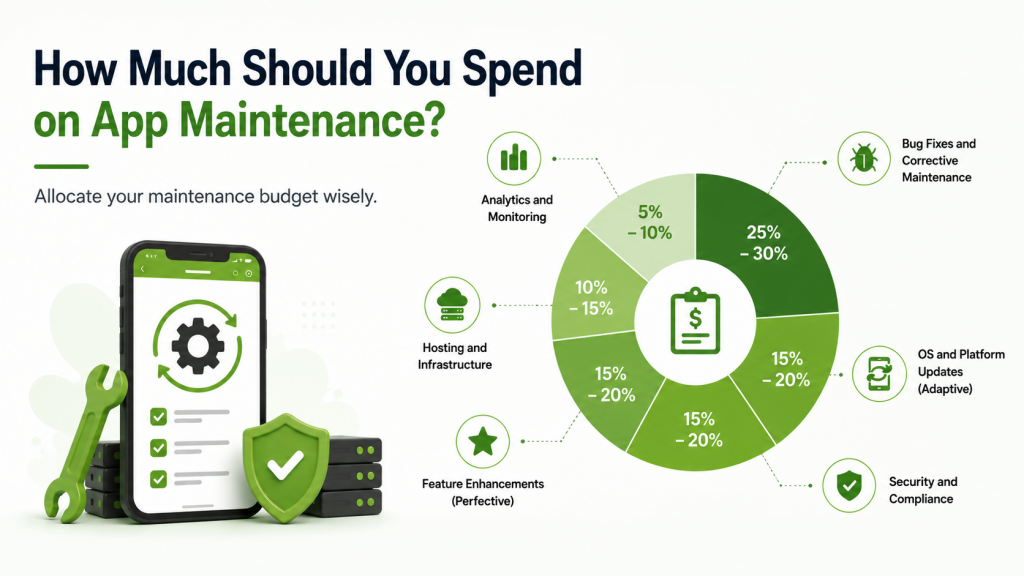
A good rule of thumb is to allocate your maintenance budget as follows.
How AI and Automation Help Reduce App Maintenance Costs
AI-powered tools are making app maintenance smarter and more cost-effective. By integrating automation into your workflow, you can reduce manual effort, catch issues earlier, and lower your overall maintenance spend. Here are six ways AI and automation help cut costs.
- AI-powered testing and automated regression: Tools like Appium, Testim, and Katalon automate regression tests by learning your app’s behavior patterns and generating test scripts automatically. Instead of your QA team manually testing every feature after each update, these tools handle it in a fraction of the time, reducing QA costs by 30% to 50%.
- Predictive crash analytics and anomaly detection: Tools like Firebase Crashlytics, Sentry, Datadog, and New Relic use machine learning to detect anomalies before they become user-facing issues. If an API call starts failing at a higher rate than normal, these crash reporting and error tracking tools flag it immediately so your team can fix it before users are affected, reducing emergency maintenance costs by 20% to 40%.
- Automated CI/CD pipelines: Tools like GitHub Actions, Bitrise, and CircleCI automate the entire build, test, and deployment process. Instead of developers manually packaging and pushing updates to app stores, CI/CD pipelines handle it with every code commit, reducing human error and cutting deployment time by up to 60%.
- AI-powered code review and security scanning: Tools like SonarQube, Snyk, and GitHub Copilot automatically scan your codebase for vulnerabilities, code quality issues, and security flaws before they reach production. Snyk specifically monitors your third-party dependencies and alerts your team when a library has a known vulnerability, reducing manual code review effort by 25% to 40%.
- Automated dependency management: Outdated third-party libraries are one of the most common sources of security vulnerabilities and app crashes. Tools like Dependabot and Renovate automatically monitor your dependencies, flag outdated packages, and create pull requests with updated versions, eliminating the manual effort of tracking library updates across your entire codebase.
- ROI timeline and cost savings: While these tools require an upfront investment, most deliver returns within three to six months. Firebase Crashlytics is free with immediate savings, Sentry ($26 to $80/month) saves $3,000 to $10,000 annually, Datadog ($15 to $23/host/month) saves $5,000 to $12,000 annually, and New Relic (free tier available) saves $4,000 to $10,000 annually in proactive issue detection.
AI and automation do not replace human maintenance teams, but they significantly reduce manual work, speed up Application Performance Monitoring (APM), and lower the overall cost to maintain an app over time.
Want to Cut Your App Maintenance Costs by Half?
Our team integrates AI-powered monitoring, automated testing, and smart maintenance workflows that can reduce your annual app maintenance spend by up to 50%
Tips to Reduce Mobile App Maintenance Cost
After developing an app, you do not want to spend an unreasonable amount on its maintenance. Therefore, here are several tips that you can implement to save on app maintenance costs.
- Choose the right app development platform
Instead of maintaining separate native apps for iOS and Android, you can invest in cross-platform app development to run your app on multiple platforms with a single codebase. Hybrid apps and Progressive Web Apps (PWAs) are also viable alternatives that reduce maintenance overhead since PWAs do not require app store submissions for every update.
Frameworks like React Native and Flutter allow you to write code once and deploy it on both iOS and Android, cutting both development and ongoing maintenance costs significantly.
- Build an MVP app first
If you are at an early stage, start with MVP app development that focuses only on essential features. Adding unnecessary features early leads to more crashes, slower load times, and higher maintenance costs. You can always integrate additional features later based on real user feedback. Fewer features mean fewer things that can break.
- Follow the latest development trends
Selecting the best app development languages and frameworks upfront is one of the most effective ways to reduce mobile app maintenance costs. Outdated libraries and design patterns force constant updates, which drive costs higher.
For your backend, modern frameworks like Node.js, Laravel, and Python-based frameworks (Django, FastAPI) offer strong community support and frequent updates. On the frontend, React remains one of the most widely supported libraries for web dashboards and admin panels.
For example, if you are building a fitness app, the fitness app development cost will be affected by trends like wearable integration, AI-powered coaching, and gamification. It is better to include these from the start rather than retrofitting them later.
- Discuss your strategy with the app development company
Before making a decision yourself, take guidance from an app development consulting partner who can help you devise a maintenance plan and custom budget. A good development partner will prioritize which tasks are essential, which can be deferred, and which can be automated to ensure your maintenance investment delivers maximum impact.
Let’s Update Your Application Now
Through this blog, you now have a clear picture of how much it costs to maintain an app in 2026. From understanding the 15% to 20% budgeting rule to breaking down costs by complexity, location, maintenance type, and team structure, you are equipped to plan your maintenance budget with confidence.
The key takeaway is that the cost to maintain an app is not an optional expense. It is a strategic investment that protects your development investment, keeps your users happy, and ensures your app remains competitive in the market.
In case you need any help estimating maintenance costs, get in touch with our consultants. We will analyze the specific sections where your app needs maintenance and help you estimate costs accurately.
FAQ About App Maintenance Costs
How much does it cost to maintain an app per month?
Monthly app maintenance costs typically range from $400 to $4,000 for small to medium apps and $5,000 to $12,500+ for complex enterprise applications. The exact figure depends on your app’s complexity, supported platforms, hosting requirements, and update frequency. As a general guideline, divide your annual maintenance budget (15% to 20% of your total development cost) by 12 to estimate your monthly maintenance expenses.
How long does it take to maintain an app?
It typically takes anywhere from 7 days to 2 months to complete an app maintenance cycle, depending on the scope of work. Minor bug fixes may take only a few days, while major feature releases, security audits, or operating system compatibility updates can take four to eight weeks. Most businesses follow a monthly or bi-monthly maintenance schedule. If your app is still in the planning or development stage, understanding how long does it take to develop an app will help you estimate both your launch timeline and your first maintenance window.
How are app maintenance costs calculated?
App maintenance costs are calculated based on developer hourly rates, maintenance hours, hosting and cloud infrastructure, third-party service subscriptions, app store fees, monitoring tools, and the complexity of ongoing updates. Many businesses follow the industry standard of allocating 15% to 20% of the original app development cost annually. Another common approach is to estimate each maintenance activity individually and calculate the total expected cost.
What happens if an app is not maintained?
If an app is not maintained, it gradually becomes unstable, insecure, and outdated. Common issues include higher crash rates after operating system updates, security vulnerabilities, broken third-party integrations, declining app store ratings, and possible removal from the App Store or Google Play due to policy non-compliance. Regular maintenance keeps your app secure, compatible, and performing as expected.
Which apps cost the most to maintain?
Apps built for regulated industries such as healthcare, finance, and government typically have the highest maintenance costs because they require continuous security updates and regulatory compliance. Applications with real-time features, complex backend architectures, and large user bases also require significantly higher ongoing investment. Understanding your industry’s maintenance requirements is essential for creating an accurate long-term budget.
Should startups budget for app maintenance?
Yes. Startups should include app maintenance in their budget from the very beginning instead of treating it as an unexpected post-launch expense. A practical guideline is to reserve 20% to 25% of the total project budget for first-year maintenance and approximately 15% to 20% annually in the following years. Planning ahead helps ensure product stability while avoiding costly emergency fixes.
Is app maintenance more expensive than app development?
Not in the short term. The initial app development investment is almost always higher than a single year of maintenance. However, over three to five years, cumulative maintenance expenses can approach or even exceed the original development cost. Building your application using scalable architecture and maintainable code significantly reduces long-term ownership costs.
How much does it cost to maintain a cross-platform app?
Maintaining a medium-complexity cross-platform application generally costs between $15,000 and $20,000 per year. Because frameworks like Flutter and React Native use a shared codebase, maintenance typically costs 30% to 40% less than maintaining separate native iOS and Android apps. If your product also includes a web application, remember to factor in the web app development cost when estimating your overall software maintenance budget.



 All our projects are secured by NDA




 4.8
4.8