
 By
By 
Contents
Before you spend months building your product, here’s a better question: what’s the fastest way to prove people actually want it?
The answer is a Minimum Viable Product (MVP). It’s one of the most effective ways to validate your product idea without burning through your time, budget, or resources.
This approach is becoming increasingly common across industries. Intel Market Research estimates the global MVP development market was valued at USD 288 million in 2024 and reached around USD 315 million in 2025. It is projected to grow to nearly USD 541 million by 2031.
That shift makes sense when you look at startup failure data. CB Insights reports that 35% of startups fail because there’s no market demand. Developing an MVP helps you test your idea early, confirm demand, and avoid building a product nobody needs.
Unlike traditional product development that requires heavy upfront investment, MVP development focuses on releasing a simplified version with only the most essential features. MVP building helps you launch faster, collect feedback from real users, and make smarter product decisions. Many teams also partner with an MVP development company to speed up building an MVP and get to market sooner.
In this blog, we’ll provide a step-by-step guide on how to build an MVP, including its main purpose, cost, common mistakes to avoid, relevant case studies, and key advantages.
What is an MVP?
An MVP (Minimum Viable Product) is the primary version of the product, comprising only the essential features. The main objective of building an MVP is to quickly launch a functional product, test hypotheses, and gather user feedback with minimal effort. This approach is essential in validating the product concept and explaining users’ preferences before starting full-scale development.
The concept of an MVP originates from Eric Ries’ Lean Startup methodology. The core idea is simple. Build, measure, and learn in rapid cycles instead of spending months on untested assumptions.
Ries defines an MVP as the version of a product that allows a team to collect validated learning with the least effort. This principle has guided companies like Dropbox, Airbnb, and Zappos from initial concept to billion-dollar valuations.
Types of MVPs and How to Choose the Right One
Not every MVP needs to be a functional product. The right type depends on your budget, timeline, and what you need to validate first. Here are the most common approaches.
1. No-code MVP
A no-code MVP uses platforms like Bubble, Webflow, or Glide to build a working product without writing code. This approach is ideal for quickly validating user workflows and interface designs. It works best when your core value proposition can be demonstrated through a web or mobile interface. Many SaaS startups use this method to test demand before hiring a development team.
2. Landing page MVP
A landing page MVP is one of the fastest ways to test market interest. You create a single page describing your product, its benefits, and a call-to-action like a signup or pre-order button. Buffer used this exact approach. The founders built a two-page website explaining the product concept. Users who clicked “Plans and Pricing” were shown a message saying the product was not ready yet. The signup interest validated the idea before any code was written.
3. Concierge MVP
In a concierge MVP, you deliver the service manually instead of building automated systems. This lets you understand the user experience firsthand before investing in technology.
Zappos is the classic example. Founder Nick Swinmurn built a simple website listing shoes. When someone placed an order, he went to a local store, bought the shoes, and shipped them himself. This proved that people would buy shoes online without building inventory or logistics systems.
4. Wizard of Oz MVP
A Wizard of Oz MVP looks automated to the user but relies on manual work behind the scenes. The front end appears like a finished product while humans handle the backend processes.
This approach works well when you need to test whether users value the output without building the complex technology to produce it. Many AI-powered product ideas start this way.
5. Single-feature MVP
A single-feature MVP focuses on one core functionality that solves the primary user problem. Everything else is stripped away. This is the most common approach for MVP app development.
Twitter started as an internal tool called Twttr with just one feature. Users could post short status updates. That single function was enough to prove the concept and attract early adopters.
Ready to Turn Your Idea into an MVP?
Don’t just sit on your startup idea; take the first step toward launching a real product. Get expert guidance to plan, validate, and build your MVP correctly.

How to choose the right MVP type
Your choice depends on three factors: what you need to validate, your available resources, and your timeline.
| MVP Type | Best For | Timeline | Budget |
| No-code MVP | Testing workflows and UI | 2-4 weeks | Low |
| Landing page MVP | Validating market demand | 1-2 weeks | Very low |
| Concierge MVP | Understanding user needs | 2-4 weeks | Low |
| Wizard of Oz MVP | Testing complex outputs | 3-6 weeks | Low to medium |
| Single-feature MVP | Proving core value | 4-12 weeks | Medium |
If you are unsure whether your idea has market demand, start with a landing page MVP. If you need to understand the user experience deeply, a concierge approach works better. For products where the technology itself is the differentiator, a single-feature MVP is the right choice.
MVP vs Prototype vs Proof of Concept: What Is the Difference?
These three terms are often confused, but each serves a different purpose in the product development journey. Understanding the difference helps you invest resources at the right stage.
A Proof of Concept (PoC) answers one question: “Can this idea work technically?” It tests feasibility, not market demand. A PoC is typically internal and never shown to end users.
A prototype is a visual or interactive model of your product. It demonstrates how the product will look and feel, but does not include real functionality. Prototypes help teams align on design before development begins.
An MVP goes further. It is a working product with real functionality that you release to actual users. The goal is to validate whether people find value in your solution and will use it repeatedly.
| Factor | Proof of Concept | Prototype | MVP |
| Purpose | Test technical feasibility | Visualize design and UX | Validate market demand |
| Audience | Internal team | Stakeholders and investors | Real end users |
| Functionality | Limited or simulated | Non-functional (visual only) | Core features work |
| Feedback type | Technical viability data | Design and usability input | Real user behavior data |
| Timeline | 1-2 weeks | 2-4 weeks | 4-12 weeks |
| Typical cost | $5,000-$15,000 | $10,000-$25,000 | $25,000-$100,000+ |
For a detailed comparison with examples, read our guide on MVP vs prototype vs proof of concept. Most successful products follow this progression: PoC first to confirm feasibility, then a prototype to refine design, and finally an MVP to test with real users. Skipping stages often leads to costly rework later.
8 Key Steps to Build a Minimum Viable Product
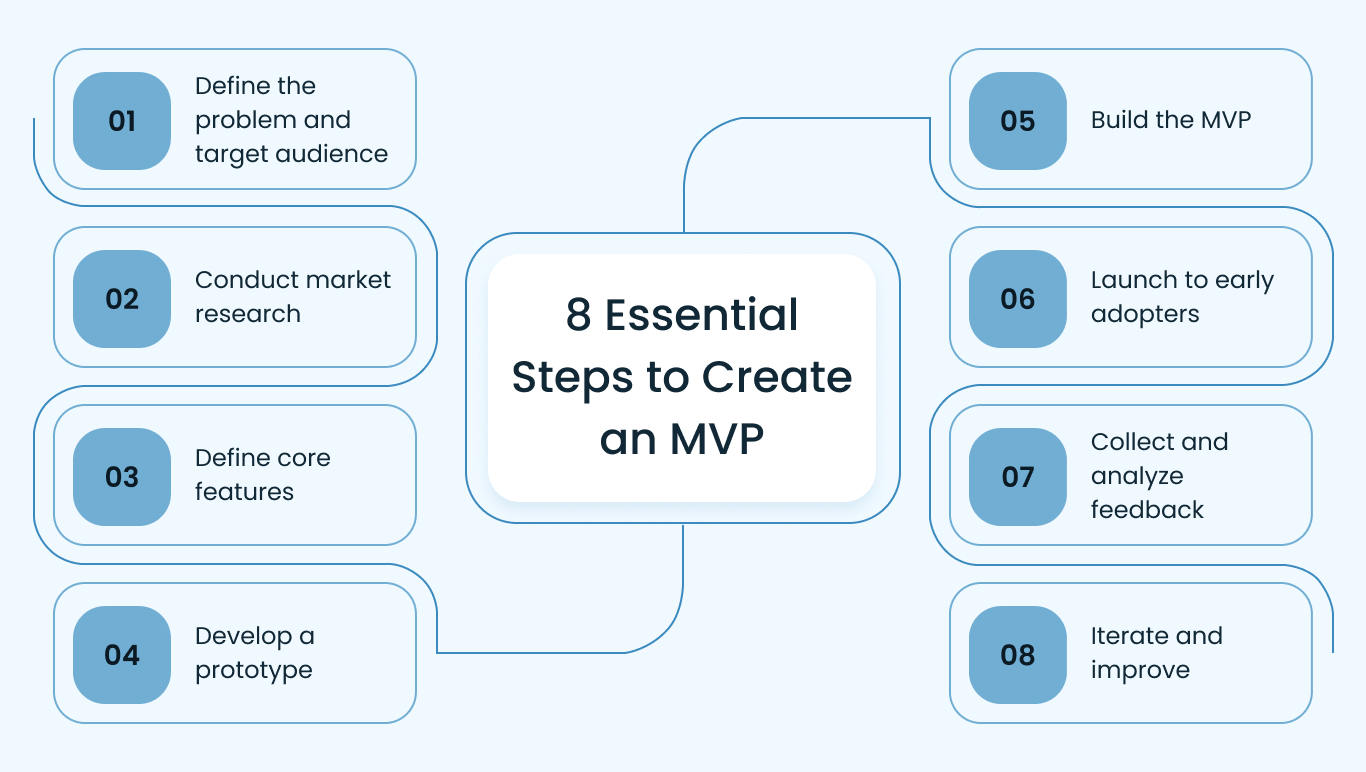
Building a Minimum Viable Product (MVP) is a strategic approach to efficiently validate product ideas. Here is a step-by-step guide to help you through the process:
1. Define the problem and target audience
The MVP development process starts with identifying the issue. Once you know the problem, you can devise a solution. Each product is created for a specific purpose or to address a particular problem. So, you need to identify the problem your product aims to solve and its respective target audiences.Understanding your target audience’s pain points and demographics is essential. This knowledge becomes the foundation for a product that resonates with their needs and preferences. Every product provides real value to customers. You must consider this while developing your minimal viable product (MVP). You should understand the problem and ensure that your MVP addresses it in the best possible way.
2. Conduct market research
Once you have identified the problems, it is time to analyze the market. Most startups fail due to a lack of market research. If your product doesn’t solve the core issue, users won’t use it.To avoid such situations, conduct market research and ensure your product meets the target market’s needs. The more information you have, the higher the chances of succeeding. When conducting market research, don’t forget to examine what your competitors offer and how to make your product stand out.Another primary reason startups fail is a lack of funds. Validate your business idea, ensure that your target audiences will pay for the products, and help your business grow further.
3. Define core features
3. Define core features
Now, it is time to define the core functionalities of your MVP or plan the scale of the minimum viable product. Initiate the process by explaining some basic features that are most important to your target market. After this, think about other features that you want to add to the product and prioritize them. Determine which functions are crucial to implement immediately and which can be added later during project development.It is advisable to set function priorities with the team. Through discussions and debates, you can determine the optimal scope for your minimum viable product.
4. Develop a prototype
4. Develop a prototype
What is the need to develop a prototype and an MVP at this step? A prototype is an early version that shows how something might work, while a minimum viable product (MVP) is a basic version of the product that performs its primary functions. Start by creating a basic prototype to visualize the user interface and experience. This preliminary model is a tool for early testing and feedback, allowing you to refine the design and functionality before full-scale development. Some of the best examples of prototypes are sketches, wireframes, and paper prototypes.
5. Build the MVP
5. Build the MVP
During the development stage, you must ensure that your MVP is bug-free and of high quality. This initial product version will enable your target users to appreciate the core value of your product, laying a strong foundation for its continued development and improvement. Another essential point to consider is the different types of MVPs. The kind of MVP significantly impacts the scope of work and development time. First, decide on the MVP type and then lay out the estimated timelines.
6. Launch to early adopters
6. Launch to early adopters
Introducing the Minimum Viable Product to early adopters is one of the most essential steps in the product development journey. These initial customers or industry experts are crucial in providing valuable feedback and validating the market fit of your product.To engage your early users, identify the communities where they gather, such as niche forums, social media groups, or professional networks. To facilitate easy communication, you can also establish open channels to gather valuable feedback, like in-app surveys or dedicated forums.
7. Collect and analyze feedback
7. Collect and analyze feedback
Collecting and analyzing user feedback helps refine your Minimum Viable Product (MVP) to ensure it aligns with user needs and expectations. Start by implementing different feedback collection methods, such as surveys, user interviews, and usability tests, to gather both quantitative and qualitative data.
After collecting the feedback, organize it in a systematic way. You can categorize it based on various themes, such as usability, functionality, and performance, to identify recurring patterns and prioritize areas for improvement.Ask your development team to analyze this data to understand the user’s challenges and preferences clearly. Prioritize the feedback based on the frequency of mentions and its impact on user satisfaction. Lastly, integrate these valuable insights into your product roadmap for iterative development.
8. Iterate and improve
8. Iterate and improve
Incorporating user feedback is essential for refining your product to meet user expectations. This approach consists of moving through planning, development, testing, and review stages, allowing for enhancements based on real-world feedback. Implementing changes based on users’ valuable insights helps developers address identified issues, enhance functionality, and improve the overall user experience. Ensure that you engage with your audiences regularly and integrate their feedback. This helps identify unforeseen challenges and achieve product-market fit.
By following these steps, businesses can build a well-structured MVP that minimizes risk and maximizes learning. To ensure faster execution and better results, many companies choose to hire MVP developers who bring the right expertise, streamline the process, and help transform ideas into scalable, market-ready products.
Tools and Platforms for Building an MVP in 2026
Choosing the right tools significantly impacts your MVP development speed and budget. Here are the most effective options by category.
| Category | Top tools | Best for |
| No-code and low-code | Bubble, Webflow, Adalo, FlutterFlow, Glide | Building functional products without extensive coding. These platforms now support complex logic and integrations. |
| Design and prototyping | Figma, Maze, UserTesting | Creating interactive prototypes before investing in development and running early usability validation. |
| Backend and infrastructure | Firebase, Supabase, AWS Amplify | Handling authentication, databases, and hosting so your team can focus on core features. |
| Analytics and feedback | Mixpanel, Hotjar, PostHog | Tracking user behavior from day one to understand how users interact with your MVP. |
| AI-assisted development | GitHub Copilot, Cursor | Accelerating development cycles, especially for MVP web development projects with tight timelines. |
For most startups, a combination of a no-code or low-code platform with a managed backend service offers the fastest path to a working MVP. Pair that with an analytics tool from the start, and you will have both a functional product and real user data to guide your next iteration. The key is to pick tools that simplify your software development process without creating technical debt that slows you down later.
5 Common Mistakes to Avoid When Building an MVP
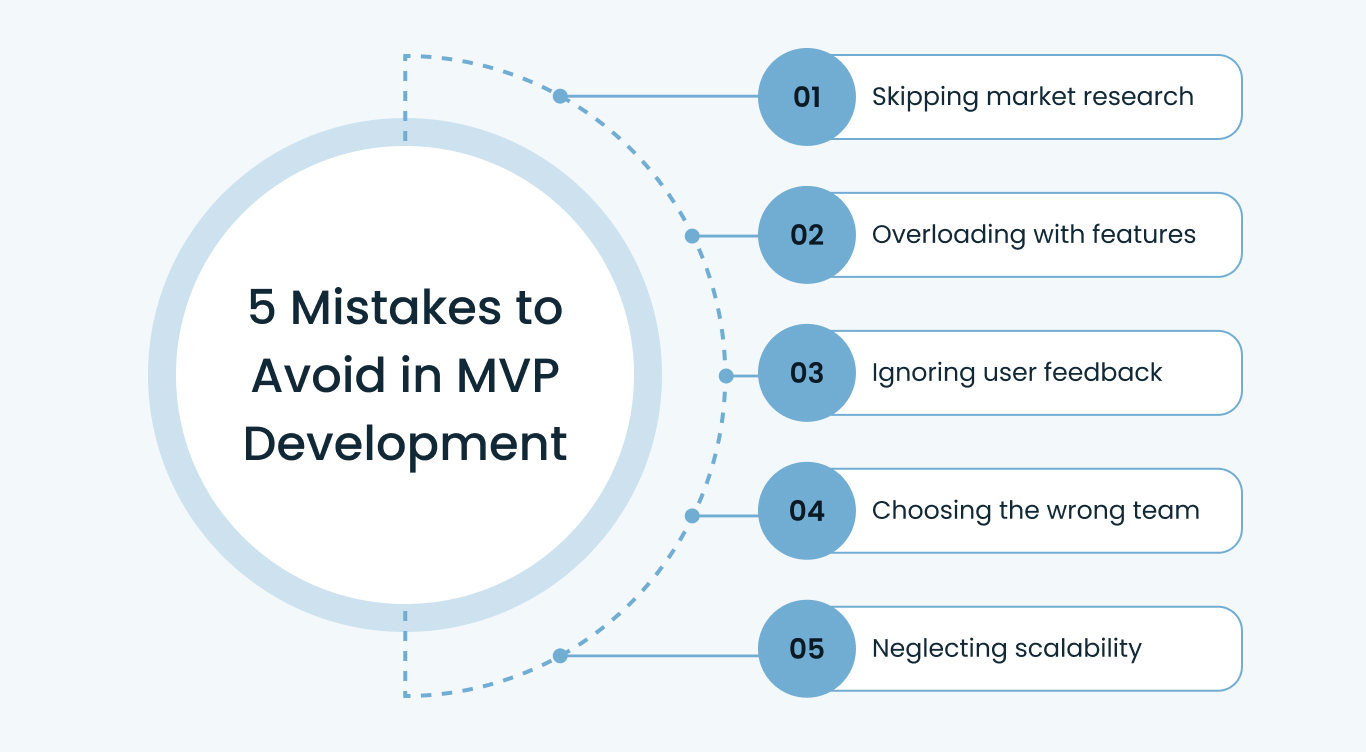
Developing an MVP comes with its challenges and pitfalls. Below are 5 common mistakes to avoid as you start your MVP development journey.
1. Skipping market research
Inadequate market research leads to creating a product that fails to address real user needs or market demand. Conduct thorough research to understand your target audience, market trends, and the competitive landscape so that you can avoid such a situation. Use this information to validate your product idea and ensure its relevance.
2. Overloading with features
One of the most common mistakes is overcomplicating the MVP by including too many features. Always focus on the main functionalities that address the core issue and provide value to users. Eliminate any unnecessary features that might delay the development process and increase costs.
3. Ignoring user feedback
Overlooking user feedback could lead you to miss opportunities for improvement. Keep seeking and analyzing user feedback to make informed decisions and improve your product. Paying attention to user feedback can ensure the success of your minimum viable product.
4. Choosing the wrong team
Selecting an inexperienced or unprofessional development team can lead to poor execution and project failure. Collaborating with a team that possesses the necessary skills and experience in MVP development for startups ensures a smooth process and a high-quality product for your organization.
5. Neglecting scalability
Focusing on immediate goals is important, but neglecting the scalability of your MVP can lead to significant challenges as your user base expands. Design your products with scalability in mind from the very beginning. This ensures its ability to handle increased demand and evolving requirements.
Understanding these common mistakes can help you navigate the challenges of MVP development. Let’s look at real-world examples of successful MVPs to see how they overcame these challenges and achieved success.
Avoid Costly MVP Development Mistakes
Work with experienced developers who know how to build MVPs that validate ideas, attract users, and satisfy investors.
Case Studies of Successful MVPs
Here are some inspiring case studies of successful Minimum Viable Products (MVPs), where organizations have turned simple ideas into global successes.
Uber
In 2009, Travis Kalanick and Garrett Camp developed UberCab, an app that enables users to book car rides in San Francisco. Their MVP focused on connecting users with drivers, offering a cashless payment option, and creating a user-friendly interface.
The MVP helped them understand the demand for cab services, which led to the expansion of Uber’s services. Furthermore, they added more services, such as Uber X and Uber Eats. Today, Uber has a presence in numerous countries, revolutionizing urban transportation.
Amazon
In 1995, Jeff Bezos started Amazon as an online bookstore. The MVP consisted of a simple website with a list of available books. Once orders were placed, Bezos would purchase the books from distributors and ship them to customers, manually handling the fulfillment process.
Opting for MVP web development helped Amazon understand customer preferences and validate the e-commerce model. With growing demand, Amazon extended its product offerings and invested in automated warehouses and logistics. Finally, Amazon evolved into a global retail giant, with its popularity worldwide.
Dropbox
Drew Houston created a simple explainer video showcasing Dropbox’s file-syncing capabilities. This deliberate move aims to gain interest and collect early feedback before full development.
Dropbox MVP’s positive reception led to a significant increase in beta sign-ups, confirming market demand. This product validation helped Dropbox to secure funding and develop a product, eventually becoming a leading cloud storage provider.
Instagram (Formerly known as Burbn)
In 2010, Kevin Systrom and Mike Krieger launched Instagram (formerly known as “Burbn”). When launched as an MVP, the application was power-packed with several features, enabling users to check in at locations, plan future check-ins, earn points, and post pictures.
During this time, the founders discovered that the photo-sharing feature was more popular than all the others. They decided to focus solely on the photo-sharing features with filters, renaming it Instagram. These changes were welcomed by the users, which led to rapid growth and the eventual acquisition by Facebook.
Need Expert Help Building Your MVP?
Our team has launched 300+ software products. Get a detailed project estimate and roadmap for your MVP idea.
These case studies showcase the potential of MVPs to drive innovation and growth. Now, let’s examine the advantages of building an MVP for your business.
What are the Advantages of Building an MVP?
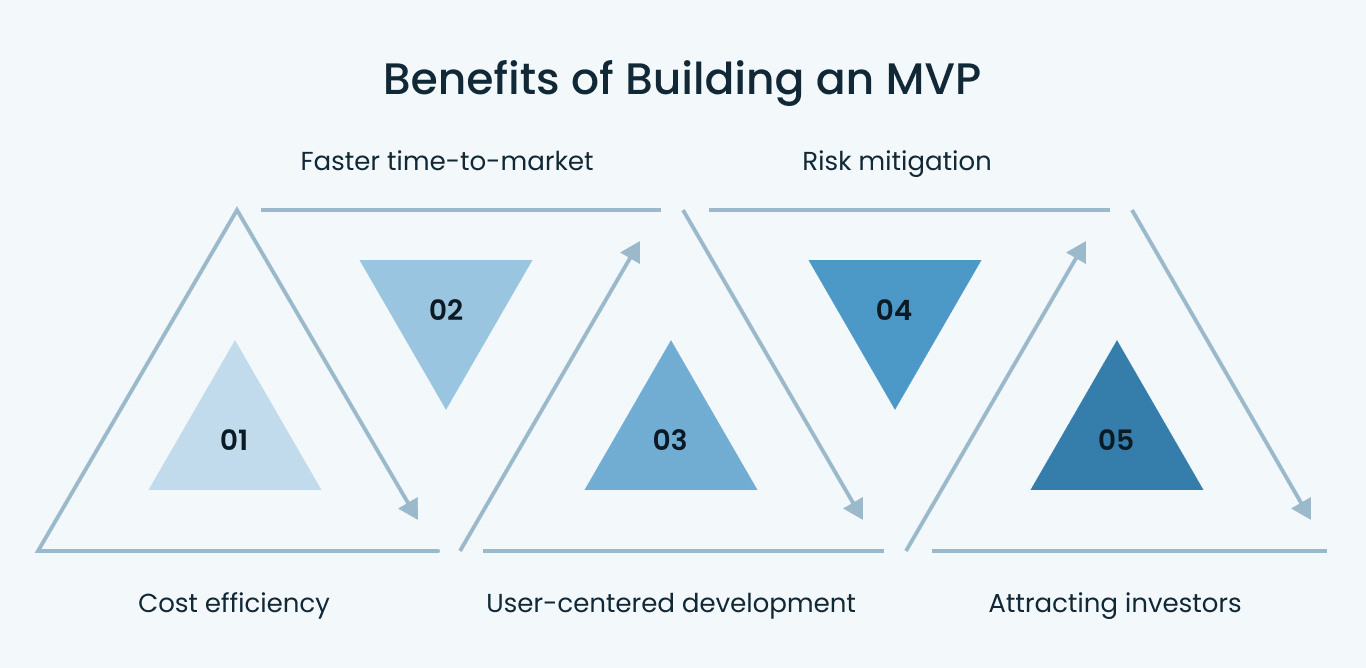
Developing a Minimum Viable Product (MVP) offers several strategic advantages for businesses aiming to introduce new products or services. Key benefits include:
Cost efficiency
Opting for an MVP helps you reduce initial development costs by focusing on the core features that solve the primary user problem. This approach enables you to allocate your resources effectively and avoid heavy investments in features that may not align with user needs.
Faster time-to-market
With an MVP, organizations can launch their product faster than the full-fledged version. This process enables organizations to establish an early market presence, gather user feedback, and make necessary adjustments. Rapid development is essential in dynamic markets where being first can provide a remarkable competitive edge.
User-centered development
An MVP provides early engagement with users, enabling organizations to get early feedback on the product’s core functionalities. This ensures that the following development aligns closely with actual user preferences and requirements. With this, you can be assured that the product will align with market demand.
Risk mitigation
MVP comes in handy for validating the product concept before investing extensive resources. Assessing the market demand from the very beginning helps businesses to identify and address potential issues, reducing the risk of product failure. This farsighted strategy enables informed decision-making regarding further investment and development.
Attracting investors
A well-prepared MVP showcases an organization’s commitment to cautious resource management and responsiveness to market needs. By displaying the initial user adoption and feedback, organizations can provide tangible evidence of the product’s potential, making it more appealing to potential investors seeking validated opportunities with reduced risk.
After understanding the benefits of building an MVP, the next question is often about the financial investment required. Let’s break down the costs involved in creating a minimum viable product (MVP).
How Much Does it Cost to Build an MVP
The average cost to build an MVP (Minimum Viable Product) ranges from $15,000 to over $ 150,000, depending on the product’s complexity and scope. The final cost largely depends on various factors, such as:
- Core features and functionalities are included in the Minimum Viable Product (MVP).
- Technology stack selected, including programming languages, frameworks, and APIs.
- Design complexity and user experience (UX) requirements.
- Developer rates vary based on expertise and region.
- Platform types include mobile (iOS and Android), web, and cross-platform solutions.
Other considerations, such as third-party integrations, compliance needs, and post-launch support, can also affect the total cost. Businesses should define a clear MVP software development plan and scope to effectively manage costs.
Considering the advantages of building an MVP, it’s crucial to establish how to measure its success and ensure that it aligns with your business goals.
How to Measure the Success of an MVP?
After launching your MVP, the most crucial step is to closely monitor its performance. Focus on tracking key performance indicators (KPIs) to scale your product’s success. Here are some essential metrics to help you evaluate its post-launch performance.
User acquisition
This metric assesses the effectiveness of your strategies in attracting users to your product. Monitoring the number of new sign-ups or downloads over a specific period provides valuable insight into the reach and appeal of your MVP.
User engagement
Assessing the number of active users interacting with your product helps its relevance and usability. Key metrics, such as Daily Active Users (DAU), Monthly Active Users (MAU), session length, and frequency of use, indicate the level of user engagement.
Conversion rates
This metric measures the percentage of users who have purchased or subscribed to the service. Higher conversion rates mean the MVP meets the user’s needs and encourages them to progress through the user journey.
Customer retention
Keep track of the number of users who continuously use your product over time, reflecting its long-term value and satisfaction. The retention rates indicate how well your MVP holds onto users. Additionally, it highlights areas where improvements are needed to maintain user engagement.
Customer feedback
Gather qualitative feedback through surveys, reviews, and direct communication to gather valuable information on user satisfaction and areas for improvement. A detailed understanding of user perceptions helps improve the product to meet the demands of the target market.
Revenue metrics
Evaluating financial performance indicators like average order value, revenue growth rate, and customer acquisition cost. These factors clearly show the MVP’s profitability and economic viability. These metrics are crucial for assessing the financial sustainability of the product.
Churn rate
Last but not least, churn rate is another important measure that needs to be closely monitored by the MVP owners. Suppose customers aren’t staying for too long, then you won’t be able to achieve the average acquisition cost, which means that your product is running at a loss.
The churn rate measures the percentage of customers who stop using a service or product within a specified timeframe, such as canceling a subscription or uninstalling an app.
Build Your MVP with a Reliable Development Partner
Avoid costly mishaps and move forward with confidence. Get expert-led MVP development services customized to your vision, timeline, and goals.
Once you’ve successfully measured the performance of your MVP, it’s time to build on that success and create a product that can take off.
Turn Your MVP into a Scalable Product With Space-O Technologies
Building an MVP is only the beginning of your product journey. The real success lies in refining, expanding, and scaling the MVP based on real user feedback and market needs. At Space-O Technologies, we offer the finest MVP development services to validate your business idea and turn it into a market-ready product.
With over 14 years of experience, we’ve worked with 115 startups and helped 35 secure Series A funding. From MVP design to full-scale product development, our team ensures your product grows with agility, reliability, and a future-ready roadmap.
Ready to scale your MVP into a full-fledged product? Contact our team at Space-O Technologies for a free consultation.
Frequently Asked Questions on How to Build an MVP
Should I build an MVP in-house or outsource development?
The choice between building an MVP in-house and outsourcing it depends on various factors. These factors consist of project timeline, technical capabilities, and resources. If your internal team is capable of handling the overall development process.
One of the best things about working with an internal team is overall control over the project. However, opting for an experienced MVP development agency can speed up time-to-market and bring in cross-industry expertise, especially when you need rapid prototyping.
Is an MVP only for startups, or can enterprises use them too?
MVPs are not meant just for startups. Enterprises use MVPs to test their new product ideas, look for innovation, and validate internal tools before investing in full-scale development. With MVPs, both startups and enterprises can reduce possible risks and make more informed decisions.
What’s the difference between an MVP and a prototype?
A prototype is a basic model meant for visualizing and validating the product design or concept. On the contrary, MVP is a functional version of the product with only the essential features that address a specific problem. You can think of a prototype as a draft and an MVP as a usable product.
How to transition from MVP to a full-scale product?
The process of transitioning from MVP to full-scale product involves analyzing user feedback, identifying which features are working, and adding new functionalities.
During this process, it is essential to maintain flexibility and pay attention to the features appreciated by the overall user base.
What industries benefit the most from MVP development?
MVP development is most suitable for industries with rapidly changing consumer demands, such as health tech, SaaS, and e-commerce.
However, any industry looking to transform or launch a new solution digitally can use MVPs to validate its ideas without a high upfront investment.
What tools are best for building an MVP quickly?
For no-code MVPs, platforms like Bubble and Webflow work well. For coded MVPs, frameworks like React, Flutter, and Node.js offer fast development cycles.
Firebase and Supabase handle backend infrastructure. The right choice depends on your product type and technical requirements.
How long does it take to build an MVP?
Most MVPs take between 2 to 6 months to develop. A no-code or landing page MVP can be ready in 1 to 4 weeks.
A single-feature coded MVP typically takes 8 to 12 weeks. Timeline depends on feature complexity, tech stack, integrations, and team size.
Can I build an MVP without coding?
Yes. No-code platforms like Bubble, Webflow, Adalo, and Glide allow you to build functional MVPs without writing code.
This approach is ideal for validating market demand and user workflows quickly. Many startups begin with no-code MVPs before moving to custom development.



 All our projects are secured by NDA




 4.8
4.8